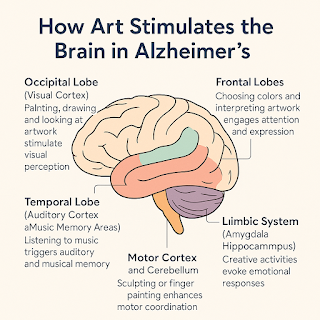
🧠 How Art Stimulates the Brain in Alzheimer’s Patients:
Even as Alzheimer’s progresses, some areas of the brain remain more resilient than others. That’s where art—whether it’s painting, listening to music, or simply viewing artwork—can make a remarkable difference.
Here are the key brain regions that art stimulates, even in individuals with Alzheimer’s:
🎨 1. Occipital Lobe (Visual Cortex)
-
Function: Processes visual information like colors, shapes, and movement.
-
Impact of Art: Painting, drawing, and looking at artwork stimulate this area, helping patients maintain visual engagement and perception.
-
Why it matters: The occipital lobe is often less affected in the early to mid-stages of Alzheimer’s, making visual arts a great way to activate cognition through sight.
🎵 2. Temporal Lobe (Especially Auditory Cortex and Music Memory Areas)
-
Function: Processes sound and stores musical memory.
-
Impact of Art: Listening to music or rhythmic sounds can trigger emotional memories and even song lyrics long after spoken language declines.
-
Interesting Fact: The medial prefrontal cortex, which links emotion and musical memory, is one of the last brain areas to degenerate in Alzheimer’s. This is why familiar music can deeply move and awaken Alzheimer’s patients.
😊 3. Limbic System (Amygdala & Hippocampus)
-
Function: Controls emotions and memory formation.
-
Impact of Art: Creative activities evoke emotional responses. Even when memory fades, the emotional experience of art often remains.
-
Real-life example: A patient may not recall their spouse’s name but may still tear up listening to their wedding song.
🧠 4. Motor Cortex and Cerebellum
-
Function: Controls movement, coordination, and tactile response.
-
Impact of Art: Sculpting, finger painting, or even handling brushes can enhance motor coordination and provide sensory stimulation.
-
Why this helps: Activating fine motor skills supports hand-eye coordination and keeps the brain-body connection alive.
💡 5. Frontal Lobes (Partially Preserved Early On)
-
Function: Involved in decision-making, creativity, and social interaction.
-
Impact of Art: Choosing colors, interpreting artwork, or participating in group art sessions can stimulate frontal areas tied to expression, attention, and social cognition.
-
Bonus: Participating in art gives patients a sense of agency and autonomy—something that’s often lost in daily care routines.
🖼️ The Brain’s Creative Lifeline
In many cases, people with Alzheimer’s still retain the ability to engage in creative tasks, even after memory and speech have declined. This is because art bypasses some of the brain’s most vulnerable regions and taps into ones that are more emotionally rooted and sensory-driven.
So when we say that art speaks when words fail, there’s neuroscience behind it.
Scientific sources:
🧠Brain Region Function and Alzheimer’s Impact
Alzheimer’s Association.
Brain tour: How Alzheimer’s affects the brain.
https://www.alz.org/alzheimers-dementia/what-is-alzheimers/brain_tour
Provides an interactive brain map and clear breakdown of affected regions during the progression of Alzheimer’s.
National Institute on Aging
(NIA).
What Happens to the Brain in Alzheimer’s Disease?
https://www.nia.nih.gov/health/what-happens-brain-alzheimers-disease
Outlines which brain regions are affected over time and how this leads to symptoms.
🎨 Programs and Real-World Applications
Museum of Modern Art
(MoMA) – Meet Me at MoMA.
https://www.moma.org/meetme/
An acclaimed program that integrates art-viewing experiences for people with dementia, backed by observational research.
Arts4Dementia UK.
https://arts4dementia.org.uk
Nonprofit with extensive documentation and reports on how art programs support people with cognitive decline.
Music
& Memory Foundation.
https://musicandmemory.org
Well-known for their work on personalized music therapy and its effects on Alzheimer’s patients, including reduced agitation and better communication.
- Inspired by This? Discover My Art!
As an artist, I’m deeply passionate about the power of art to bring peace, joy, and new ways of expressing ourselves—especially for children and families.
🌟 You can explore my original paintings, designed to inspire tranquility and happiness, on my Etsy Shop https://faripalette.etsy.com
🌟 Follow my creative journey and get daily inspiration on @fari.arts4444Every piece I create is made with heart, imagination, and the belief that art can be a bridge to something beautiful—whether that’s a feeling, a conversation, or a brand new dream. 💛
Thank you for supporting handmade art and creative expression!
-