🎨 How Art Boosts Learning in Preschoolers: More Than Just
Fun with Paint
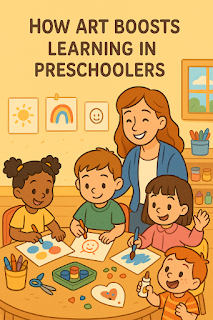
When you walk into a preschool classroom, the sight of tiny hands smeared in paint and colorful masterpieces drying on the walls might look like simple play. But behind every finger painting and glittery collage is a powerful tool for learning. Art, especially in the early years, does far more than just spark creativity — it actively fuels development across all learning domains.
In this blog, we’ll explore how art impacts the learning process in preschoolers, and why those messy moments with crayons and clay are essential for young minds to grow. ✨
🧠 1. Art Strengthens Cognitive Development
Art activities may look spontaneous, but they’re full of brain-boosting opportunities. When children engage in creating, they’re making decisions, solving problems, and experimenting with cause and effect. Want to mix blue and yellow? They’re learning about color theory. Want to build a tall tower from playdough? They’re discovering balance and spatial awareness.
Art also introduces early math and science concepts without the pressure of formal instruction. Think about it:
-
Shapes and patterns in collage work build early geometry skills.
-
Measuring ingredients for homemade playdough teaches volume and proportions.
-
Noticing texture and color changes during painting links to sensory science learning.
What’s beautiful about this process is that it’s exploration-first — children are naturally motivated to learn because it’s tied to something fun and meaningful.
🗣️ 2. Language and Communication Grow Through Art
Have you ever asked a preschooler about their drawing and heard the most elaborate story? Art provides a perfect launchpad for self-expression and storytelling. When children create something, they often want to talk about it. This builds their vocabulary, strengthens sentence formation, and boosts confidence in sharing ideas.
In a preschool setting, art activities can also foster social communication. Children learn to:
-
Describe what they’re doing.
-
Share tools and space.
-
Collaborate on group projects.
-
Listen and respond to others.
By encouraging discussion around art, teachers and caregivers help kids develop their verbal and listening skills, laying the groundwork for literacy development.
✋ 3. Fine Motor Skills Get a Workout
Art is a powerhouse for developing fine motor skills — the small muscle movements needed for writing, buttoning clothes, or using scissors. Whether it’s holding a paintbrush, squeezing glue bottles, or tearing paper, every small action is practice for more complex physical tasks.
When kids are cutting shapes, threading beads, or molding clay, they’re building hand-eye coordination and muscle strength. These improvements have a ripple effect:
-
Better control when writing letters.
-
More ease with drawing and coloring inside lines.
-
Greater independence with daily self-care tasks.
It’s amazing how something as simple as drawing with chalk can prepare a child to one day tie their own shoes or hold a pencil correctly.
❤️ 4. Art Builds Emotional and Social Intelligence
Preschoolers are still learning how to understand and express their emotions. Art gives them a safe and open-ended outlet to explore those feelings. Whether it’s a joyful rainbow or a stormy swirl of dark paint, children often use color, shape, and movement to communicate their inner world.
In addition to helping kids manage emotions, art teaches patience, perseverance, and flexibility. A painting may not turn out as expected — that’s okay. Children learn to adapt, try again, and build resilience. Art also encourages pride and self-esteem. There’s nothing quite like the glow on a child’s face when their creation is hung up for others to see.
From a social perspective, shared art experiences help children understand different perspectives. Group murals, shared sculptures, and collaborative storytelling all require empathy and cooperation.
🌱 5. Art Supports Holistic Learning — And It’s Joyful!
Most importantly, art taps into the joy of learning. Preschoolers are natural artists, and giving them space to explore that through paint, clay, collage, and drawing makes them feel empowered and curious. When kids are having fun, they’re more open to learning. It becomes part of their play, not something imposed on them.
Incorporating art into early childhood education supports whole-child development. It touches every area: cognitive, physical, social, and emotional. And perhaps most beautifully, it teaches that there’s no “wrong” way to learn — just like there’s no wrong way to make art.
Final Thoughts
As parents, educators, and caregivers, we can nurture a love for learning by giving children the time and space to create freely. Whether it’s scribbles on the wall or a carefully glued craft, every piece of art is a stepping stone in a child’s journey to becoming a thinker, a communicator, and a confident learner.
So the next time your little one brings home a paper full of dots, swirls, and glitter, know this: you’re not just looking at a drawing — you’re witnessing their brain growing, their skills sharpening, and their spirit shining.
🛍️ Browse my Abstract paintings full Etsy store here: https://faripalette.etsy.com
https://www.instagram.com/fari.arts4444/
Faripalette (Farzaneh Sedighian, BSc, MSc, PhD candidate)
📚 References & Sources
-
Edwards, C., Gandini, L., & Forman, G. (2011).
The Hundred Languages of Children: The Reggio Emilia Experience in Transformation. Praeger.
→ Explores how creative expression and art are central to cognitive and emotional development in early childhood. -
Berghoff, B. (2003).
Beyond Reading and Writing: Inquiry, Curriculum, and Multiple Ways of Knowing.
→ Discusses how integrating art into preschool curriculum enhances thinking and problem-solving. -
National Endowment for the Arts (2011).
The Arts and Achievement in At-Risk Youth: Findings from Four Longitudinal Studies.
→ Shows the long-term cognitive and social benefits of arts participation beginning in early childhood. -
Jalongo, M. R. (2007).
Early Childhood Language Arts (4th ed.). Pearson.
→ Highlights the relationship between art activities and language/literacy development in young children. -
Ginsburg, K. R. (2007).
The Importance of Play in Promoting Healthy Child Development and Maintaining Strong Parent-Child Bonds. Pediatrics, 119(1), 182–191.
→ Emphasizes the critical role of creative play (including art) in holistic learning and emotional regulation. -
NAEA (National Art Education Association).
https://www.arteducators.org
→ Offers extensive research and resources about the benefits of art education in early childhood. -
Catterall, J. S. (2009).
Doing Well and Doing Good by Doing Art. I-Group Books.
→ Provides evidence that arts participation helps boost academic performance and personal development. -
The National Association for the Education of Young Children (NAEYC).
https://www.naeyc.org/resources/topics/arts
→ Offers developmental guidelines and position statements about the importance of art in early childhood education. -
Goldhawk, S. (2010).
Why Art is Important for Early Childhood Development. The Artful Parent.
→ A practical summary of how art supports emotional, motor, and language development in preschoolers. -
Althouse, R., Johnson, M. H., & Mitchell, S. T. (2002).
The Colors of Learning: Integrating the Visual Arts into the Early Childhood Curriculum. Teachers College Press.
→ A detailed guide on how art supports learning and development in preschool environments.