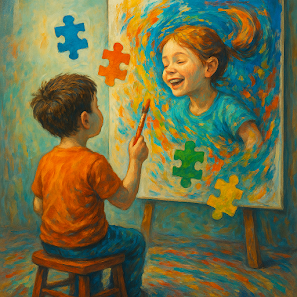
Art has a magical way of reaching places words sometimes can’t
For children on the autism spectrum, who may face challenges with verbal communication, painting, drawing, sculpting, and even simply experiencing art can open powerful new pathways to self-expression. Research and stories from families around the world show that artistic activities can be much more than just fun—they can actually help children start using words, build confidence in speaking, and feel more understood.
Let’s explore how art can help children on the spectrum find their voice—and how you can use it every day.
Art as a Non-Verbal Bridge
Many children on the autism spectrum think and feel in rich, detailed ways—but getting those thoughts into words can be overwhelming. Verbal communication demands quick processing, social judgment, and motor control, which can all be areas of difficulty.
Art doesn’t demand words right away.
Instead, it offers a peaceful, accepting space where a child can explore, make choices, and express emotions without needing to explain themselves immediately. Whether through color, shapes, textures, or images, children can “say” things on the canvas or paper that they might not yet be ready or able to say out loud.
And here’s the magic:
After creating art, children often want to talk about what they made. This gentle encouragement can lead to natural, low-pressure opportunities to use new words and build sentences.
For example:
-
A child paints a rainbow and then says, “happy!”
-
A child draws a stormy cloud and says, “sad” or “rain.”
-
A child sculpts a favorite animal and proudly says its name.
The art acts like a “launch pad” for language.
Watching Art: A Quiet Invitation to Speak
It’s not just making art that can spark communication—looking at art can be just as powerful.
When children visit an art exhibit, look through a picture book, or even watch videos of colorful paintings being made, they are invited to react emotionally. And emotions are tightly linked to language development.
You can support this by asking simple, open-ended questions like:
-
“What do you see?”
-
“What color do you like the most?”
-
“How does this picture make you feel?”
Even if your child only points at first or makes a small sound, you can model the language:
“You’re pointing at the big tree! That’s a tall tree!”
Gradually, children often begin to imitate, label, and eventually describe what they see.
Key Tip: Avoid pressuring them to answer.
The goal is to invite communication, not force it. Even a one-word response, a gesture, or a sound is a wonderful step forward.
Why Art Helps Speech Emerge: The Science Behind It
You might be wondering—why does art work so well for children on the spectrum?
Here are a few reasons:
-
It activates multiple parts of the brain.
Visual processing, emotional regulation, fine motor skills, and sometimes even memory and sensory integration are all involved in creating and experiencing art. This “whole brain activation” helps children connect different types of information, including language. -
It reduces performance anxiety.
Speaking can feel scary when there’s pressure to “get it right.” In contrast, art-making is freeform and validating. Success isn’t based on rules—it’s based on personal expression. This builds confidence, which naturally helps children take risks with words. -
It taps into sensory strengths.
Many children on the spectrum are highly sensitive to textures, colors, and patterns. Art uses these strengths and turns them into a bridge toward communication. -
It gives a sense of control.
Children often choose the colors, materials, and subjects they want to explore. This sense of autonomy helps boost their motivation to share their choices and experiences verbally.
Easy Ways to Start Using Art for Communication at Home
You don’t need to be a professional artist or therapist to help your child use art as a language tool. Here are a few simple ways to get started:
-
Set up an art station with basic supplies (paper, markers, crayons, clay).
-
Offer choices (“Do you want blue or red?”) and wait for a verbal or non-verbal response.
-
Describe their art enthusiastically (“Wow! You made a swirly blue sky!”) to model language.
-
Use art books with vivid images and ask casual questions.
-
Watch painting videos together and talk about the colors and movements.
-
Celebrate every attempt to communicate—whether it’s a word, a sound, or a smile.
Most importantly:
Keep it joyful, pressure-free, and led by the child’s interests. When children feel safe and empowered, their desire to share grows naturally.
Final Thoughts: Art as a Journey Toward Connection
For children on the autism spectrum, art is so much more than a creative outlet.
It’s a pathway to communication, a boost to confidence, and a celebration of their unique way of seeing the world.
Whether they are holding a paintbrush, molding clay, or simply looking at a bright painting on a wall, children are building bridges—one color, one shape, one word at a time.
And every word that blossoms from that process is a masterpiece in itself. 🎨✨
For children on the autism spectrum, art is so much more than a creative outlet.
It’s a pathway to communication, a boost to confidence, and a celebration of their unique way of seeing the world.
Whether they are holding a paintbrush, molding clay, or simply looking at a bright painting on a wall, children are building bridges—one color, one shape, one word at a time.
And every word that blossoms from that process is a masterpiece in itself. 🎨✨
Inspired by This? Discover My Art!
As an artist, I’m deeply passionate about the power of art to bring peace, joy, and new ways of expressing ourselves—especially for children and families.
🌟 You can explore my original paintings, designed to inspire tranquility and happiness, on my Etsy Shop https://faripalette.etsy.com
🌟 Follow my creative journey and get daily inspiration on @fari.arts4444
Every piece I create is made with heart, imagination, and the belief that art can be a bridge to something beautiful—whether that’s a feeling, a conversation, or a brand new dream. 💛
Thank you for supporting handmade art and creative expression!